State Medicaid Agency - ServiceNow Platform
@KPMG @State & Local Medicaid
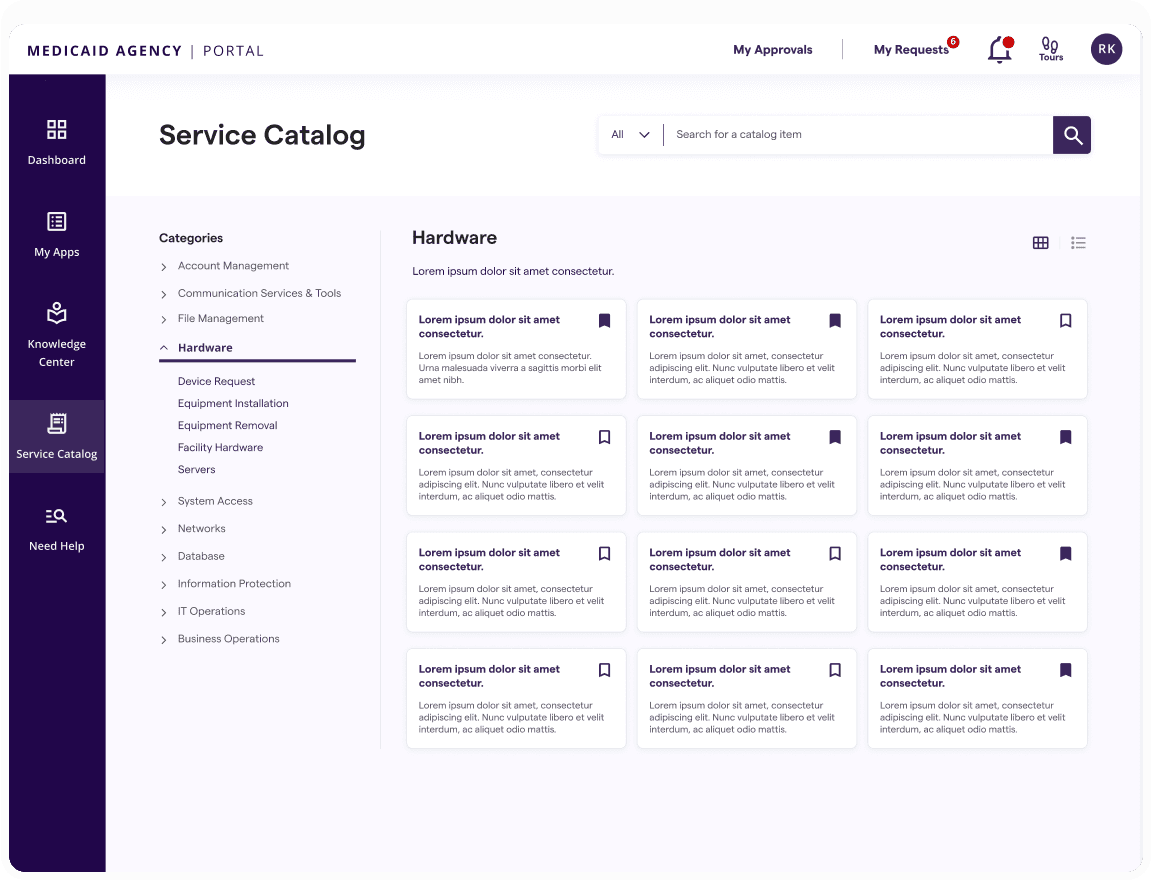
Reorganized the information architecture of a State Medicaid IT Services portal to help 1,200+ employees locate, submit, and track service requests more efficiently.
Scope
Information Architecture, User Research, UI Design, ServiceNow Platforms
Role
UX/UI Designer
Industry
State & Local Government
Timeline
Apr 2023 - May 2024
Tools
Figma, ServiceNow
Background
“I’m lost. How do I find the request form? Is there a correct way to fill it out?”
The State Medicaid IT Services platform was built to be technically robust but not user-centered. As a result, employees frequently struggled to locate the correct request forms, complete submissions accurately, and track their requests. Over time, the system lost its effectiveness as a self-service tool and required repeated back-and-forth communication with approvers and peers, slowing down operational workflows and reducing confidence in the platform.
The redesign simplified navigation, improved form usability, and enabled a more effective self-service experience across the organization.
Our Challenge
How might we make it easier for State Medicaid employees to successfully and efficiently use the IT Services portal to obtain the tools and support they need for daily work?
Project Goal
Restructure the IT Services portal to improve request accuracy, clarify process visibility, and provide accessible guidance, allowing users to navigate the system more confidently and rely less on manual support
My Role
As UX/UI Designer, I led the information architecture redesign and restructured the IT Services portal to improve discoverability, usability, and request accuracy. I translated research insights into a clearer category system, redesigned core flows, and collaborated with stakeholders to ensure the platform aligned with operational and technical constraints.
Goals -> Outcomes
How I played a key role in solving identified problems
While I cannot share screens and details due to an NDA meant to protect the State Medicaid program, I can share how I played a key role in solving the problems discovered in our user research.
Enhance User Navigation -> Reorganized the IT request items into user-friendly categories, making it easier for users to find and submit their requests without errors.
Improve Information Accessibility -> Created an enhanced knowledge portal that surfaces relevant information prominently, enabling users to efficiently access guidance.
Increase System Usability -> Ensured that the request forms are intuitive, reducing confusion and inaccuracies in data input by guiding users more effectively through the submission process.
Promote Self-Service -> Encouraged users to solve their issues independently by providing thorough guidelines and easy access to information, thus reducing dependency on IT admin.
Build for the Future -> Established request form guidelines and structures that can be easily maintained and adapted, ensuring the long-term success and scalability of the solution.
Obstacles
How I worked with my team to better communicate with IT stakeholders
The team faced many challenges throughout this project, but we steadily resolved them and came out with important lessons. Below, I have highlighted one of the major challenges that I helped to resolve.
“
How do we effectively communicate with the State Medicaid IT Department whose vision is misaligned with the project vision and business goals?
Context → The IT department’s primary concern was how the proposed changes would affect their existing workflows and long-term system maintenance. Their focus on operational stability initially created some misalignment with the project’s usability goals.
Addressing the challenge → Recognizing the importance of their buy-in, we involved IT stakeholders more closely throughout the design process and created detailed design, technical, and business documentation to clearly show how each UX change would impact existing workflows and system behavior. I also helped present these changes to ensure shared understanding and alignment.
Outcomes → As stakeholders gained better visibility into our process and rationale, their confidence in the proposed changes grew. This led to more constructive, actionable feedback and stronger collaboration, ultimately improving the feasibility and effectiveness of the final solution.
Opportunities
If I could, I would...
Service request forms were created by multiple administrators over time, leading to inconsistencies that contributed to user frustration. Improving form structure and standardization would further enhance usability, but this work fell outside the project scope.
Additionally, deeper understanding of backend ServiceNow processes would enable more sustainable improvements to the submission experience. Future projects could involve closer collaboration with backend experts to better align front-end design with system behavior.
More comprehensive documentation of design and stakeholder decisions would also improve accountability/continuity during implementation and maintenance.